


Q-Switch Laser vs CO₂ Laser: Choosing the Right Option
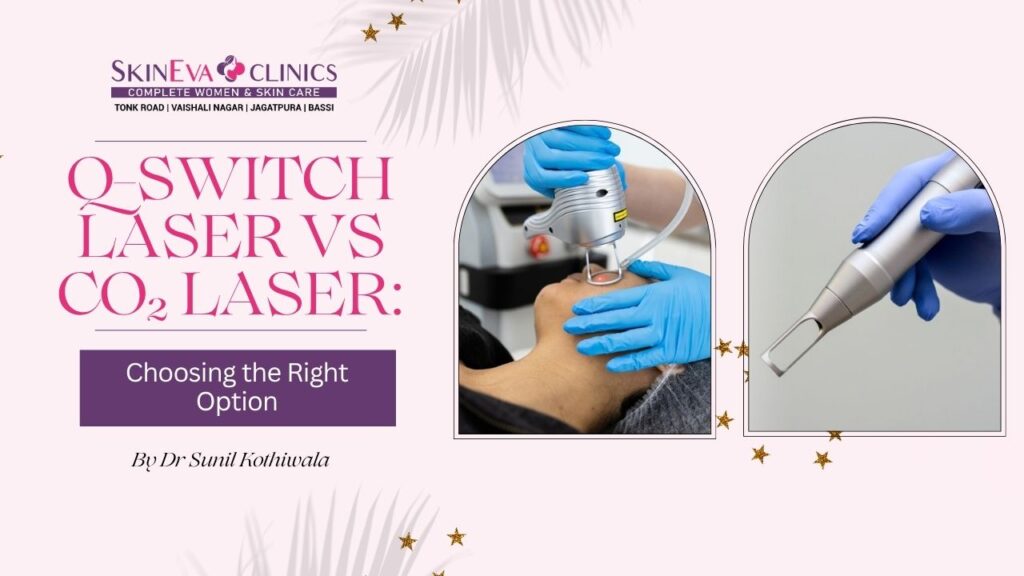
A Q-Switch laser is mainly a pigment-targeting laser with little to no downtime, used for dark spots, tanning, freckles, post-acne marks and tattoos. A fractional CO₂ laser is a resurfacing laser with 5 to 7 days of healing, used for acne scars, rough texture, open pores and wrinkles. They solve different problems and are not interchangeable. The right choice depends on what exactly needs to be treated.
“Which laser is better?” is one of the most common questions we hear at our clinic. The honest answer is that neither is better in general. One is built to clear pigment, the other to rebuild skin texture. Choosing the wrong one can mean wasted sessions or, worse, pigmentation problems. This guide explains how each works, where each fits and how to decide.
How Does Q-Switch Laser Work?
A Q-Switch laser (usually Nd:YAG) releases energy in extremely short, high-power pulses lasting nanoseconds. Pigment or tattoo ink absorbs this energy and shatters into microscopic particles, which the body’s immune system gradually clears. Because the pulses are so brief, little heat spreads, and the surface of the skin is generally preserved.
It commonly works at two wavelengths:
- 1064 nm: Goes deeper and is often preferred for deeper pigment and darker skin tones.
- 532 nm: Targets superficial brown pigment such as freckles and sun spots.
Best for: Sun spots, freckles, tanning, flat post-acne marks (post-inflammatory hyperpigmentation), selected melasma cases, birthmarks and tattoo removal.
How Does Fractional CO₂ Laser Work?
A CO₂ laser is an ablative laser that emits infrared light at about 10,600 nm, which is absorbed by water in the skin. In fractional mode, it creates thousands of microscopic columns of controlled injury and leaves healthy skin between them. The untreated skin speeds up healing, and the repair process builds new collagen, gradually smoothing scars and refining texture.
We use Alma’s Pixel CO₂ laser, which also has a continuous (surgical) mode for removing moles, skin tags and warts. For cosmetic concerns, the fractional mode is used.
Best for: Depressed acne scars (rolling, boxcar), post-surgical and traumatic scars, stretch marks, open pores, rough texture, wrinkles and sun-damaged skin.
Q-Switch vs CO₂ Laser: Side-by-Side Comparison
| Feature | Q-Switch Laser | Fractional CO₂ Laser |
| Main purpose | Pigment correction, tattoo removal | Skin resurfacing, scar and texture repair |
| Technology | Non-ablative, nanosecond pulses | Ablative, microscopic thermal columns |
| Targets | Melanin and tattoo ink | Water in skin, triggering collagen remodelling |
| Best for | Dark spots, tanning, freckles, post-acne marks, tattoos | Acne scars, open pores, wrinkles, rough texture |
| Downtime | Minimal to none | About 5 to 7 days for scars; 2 to 3 days for light rejuvenation |
| Sensation | Quick snapping or stinging | Heat and “pins and needles”, numbing cream needed |
| Typical sessions | Often 4 to 6 or more, 4 to 8 weeks apart | Scars: 3 to 4 sessions, 2 to 3 months apart |
| Skin tone caution | Pigment changes possible, 1064 nm often used | Needs more experience on skin types IV and V |
| Results begin | Gradual lightening over sessions | Usually from the second month |
Which Laser Is Better for Pigmentation?
Q-Switch is generally the more direct option for pigment, since it is designed to interact with melanin. It suits sun spots, freckles, tanning and flat post-acne marks.
Melasma needs extra care. It is a chronic, hormone- and sun-sensitive condition. Q-Switch may help in selected cases with gentle settings, but aggressive treatment can worsen it. It is usually part of a plan that includes topical treatment and strict sun protection.
Fractional CO₂ is not a first-line treatment for pigmentation alone. It may be considered when pigmentation sits alongside significant scarring or texture problems.
Which Laser Is Better for Acne Scars?
Fractional CO₂ is generally the better choice for true, textural acne scars, because it remodels skin and collagen rather than only targeting colour.
Q-Switch can fade the brown or dark pigment left behind by old pimples, but it cannot lift or fill an indented scar.
Post-acne marks vs acne scars: they are not the same.
| What you see | What it usually is | Usually treated with |
| Flat brown or grey mark | Pigmentation (PIH) | Q-Switch, topical creams, sunscreen |
| Indented scar | Structural collagen loss | Fractional CO₂, microneedling, subcision |
| Red mark | Inflammation or vascular change | Depends on cause; a dermatologist should assess |
| Raised scar | Excess scar tissue | A different approach, sometimes steroid injections |
Using aggressive resurfacing for flat marks, just because they are called “acne scars,” means treating the wrong problem.
Which Laser Is Better for Skin Texture and Open Pores?
Fractional CO₂ is more suitable for rough skin texture, enlarged pores, fine lines and surface damage caused by the sun. Q-Switch laser toning can improve overall brightness and mild texture, but it is not a resurfacing laser and will not give the same collagen-remodelling effect.
Which Laser Is Safer for Indian and Darker Skin Tones?
Neither laser should be chosen by skin colour alone, and neither is automatically “safe.”
- Q-Switch: With longer wavelengths (1064 nm) and conservative energy, it can be used in many Indian skin tones. Risks still include post-inflammatory hyperpigmentation, lightening (hypopigmentation), blistering and uneven response.
- Fractional CO₂: Because it is ablative, it needs greater caution on skin types IV and V. Inflammation can trigger pigmentation changes. Very dark skin (type VI) is generally not suitable.
What improves safety in both cases is the same:
- An experienced dermatologist who has treated your skin tone often
- A clear diagnosis before treatment
- A test patch when needed
- Priming with sunscreen and lightening creams before CO₂ laser, especially for scars
- Conservative settings and strict aftercare
We have used the Pixel CO₂ laser extensively on skin types III, IV and V and follows protocols designed for darker skin.
Can You Combine Both Lasers?
Yes, and many patients with mixed concerns benefit from it. For example, someone with both depressed acne scars and brown post-acne marks may have fractional CO₂ for the scars and Q-Switch toning for the pigment, planned in the right sequence and with enough gap between them. Depending on the case, plans may also include subcision, chemical peels, microneedling or topical treatments. A combined plan should always be set by a dermatologist rather than chosen by device name.
How to Choose: A Quick Guide
| Your main concern | Likely better option |
| Sun spots, freckles, tanning | Q-Switch |
| Flat post-acne dark marks | Q-Switch (plus sunscreen and topicals) |
| Tattoo removal | Q-Switch |
| Melasma | Gentle Q-Switch toning within a combined plan |
| Depressed acne scars | Fractional CO₂ |
| Open pores, rough texture | Fractional CO₂ |
| Wrinkles, sun-damaged skin | Fractional CO₂ |
| Scars plus pigmentation | A planned combination |
| No time for downtime | Q-Switch, or low-intensity settings |
The right question is not “Which laser is stronger?” but “What exactly needs to be treated?” That is why a proper skin examination comes before any device is chosen.
Conclusion
Q-Switch and CO₂ lasers are different tools for different problems: one clears pigment with little downtime, the other rebuilds skin texture and scars with a short healing period. The best results come from an accurate diagnosis, the right laser (or combination) for your skin tone, and careful aftercare.
Not sure which one you need? A consultation can settle it. At Dr. Kothiwala’s SkinEva Clinic, Jaipur, your skin is examined first, and the plan is personalized to your concern, skin type and schedule.
Frequently Asked Questions
Is CO₂ laser more painful than a Q-Switch?
Generally yes. CO₂ involves more heat and needs numbing cream, while Q-Switch feels like quick snaps.
Which laser has more downtime?
CO₂ laser. Scar treatment needs about 5 to 7 days of healing, while Q-Switch has little to none.
Which laser is safer for Indian skin?
Both can be used safely by an experienced dermatologist. CO₂ needs more caution on darker skin because of pigmentation risk.
Can I have both treatments?
Yes, if you have both scars and pigmentation. Your dermatologist will plan the order and spacing.
How many sessions does each need?
Q-Switch usually needs several sessions at 4 to 8 week intervals. CO₂ for scars usually needs 3 to 4 sessions, 2 to 3 months apart.
Leave a Comment