


Laser Hair Removal with Alma Soprano Titanium: How It Works, Benefits & What to Expect
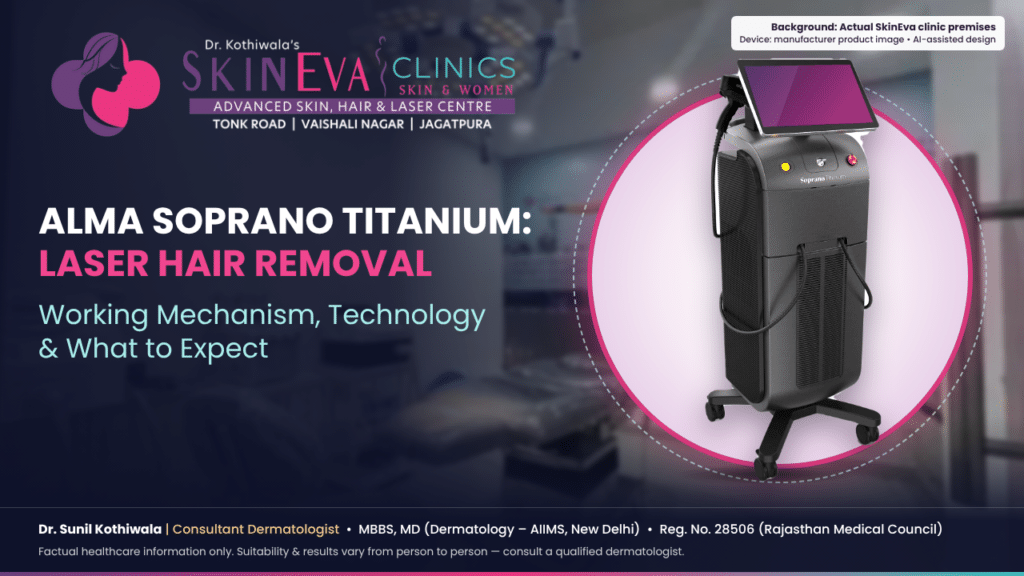
Alma Soprano Titanium is a diode laser system that removes unwanted hair using three wavelengths (755 nm, 810 nm and 1064 nm) in one applicator. Instead of one sharp, painful pulse, it glides over the skin and heats the hair follicle gradually. This makes the treatment comfortable and suitable for Indian skin tones (Fitzpatrick I–VI), including tanned skin. Most people need around 6 to 8 sessions, spaced 4 to 8 weeks apart, to get long-lasting hair reduction.
What Is Alma Soprano Titanium?
Alma Soprano Titanium is a professional laser hair removal system developed by Alma Lasers. It is FDA-cleared for hair removal across all skin types. Older lasers use one wavelength, so they work well only on a limited range of skin and hair types. Soprano Titanium combines three wavelengths at once, so one session can reach follicles at different depths.
This technology is used for patients who want comfortable, safe and effective laser hair removal without the sting associated with older machines.
How Does It Work?
Laser hair removal works on a simple principle. Melanin gives hair its colour and is present in hair follicles. The laser targets this pigment, converting light energy into heat that damages the follicle and reduces its ability to grow strong hair.
Soprano Titanium does this with two key technologies.
- SHR (Super Hair Removal) with In-Motion technique
Traditional lasers deliver one high-energy pulse in a single spot. This is what causes the “rubber band snap” feeling. With SHR, the handpiece keeps moving over the skin while firing many low-energy pulses rapidly. Heat builds up gently in the follicle without overheating the skin surface. Most patients find the treatment warm and comfortable. - ICE Plus™ sapphire cooling
The sapphire tip continuously cools the top layer of the skin during treatment. This protects the skin surface and adds to patient comfort.
The Three Wavelengths Explained
| Wavelength | Type | Best For |
| 755 nm | Alexandrite | Fine, light-coloured hair; superficial areas like upper lip and eyebrows |
| 810 nm | Diode | The standard hair removal wavelength; deep follicle penetration; arms, legs, cheeks, chin |
| 1064 nm | Nd:YAG | Deepest penetration with lower melanin absorption; darker or tanned skin; underarms and bikini area |
Because hair on the body is never uniform, with fine hair on the face and coarse hair on the legs or underarms, combining all three wavelengths helps treat different hair types in the same session.
Key Benefits of Soprano Titanium Laser Hair Removal
- Comfortable treatment: Gradual heating and continuous cooling make it far more tolerable than older lasers.
- Suitable for all skin tones: It is cleared for Fitzpatrick skin types I to VI, which matters in India, where most patients have medium to deep skin tones.
- Works on tanned skin: Treatment does not have to wait for a tan to fade, and it can be done at any time of the year, subject to your dermatologist’s assessment.
- Faster sessions: The large 4 cm² spot size covers more area per pass, which reduces treatment time for bigger areas like legs and back.
- Treats multiple hair types: Fine, medium and coarse hair respond because of the multi-wavelength approach.
- Minimal downtime: Most people resume normal activities right after the session.
- No consumables: The system does not rely on disposable parts for each treatment.
Which Areas Can Be Treated?
Soprano Titanium can treat almost any area with unwanted hair:
- Face: upper lip, chin, sideburns, forehead, full face
- Underarms
- Arms and legs
- Bikini line and intimate areas
- Chest, abdomen and back
- Neck and shoulders
The approximate treatment time is 30 minutes for the face or bikini area, about 1 hour for limbs, and 1.5 to 2 hours for the full body. This includes photography, shaving and the laser itself.
How Many Sessions Will You Need?
Laser works only on hair in the active growth (anagen) phase. At any time, only a portion of your hair is in this phase, and the rest is resting or shedding. That is why a single session cannot remove all hair.
- Typical course: 6 to 8 sessions
- Gap between sessions: 4 to 8 weeks, depending on the body area
- Results: Hair becomes visibly finer, sparser and slower-growing after each session
The exact number depends on your hair thickness, skin type, hormonal factors and the treated area. For example, women with hormonal conditions such as PCOS may need maintenance sessions, because hormones can keep stimulating new hair growth.
Is It Really “Permanent”?
Honesty matters here. Laser hair removal is best described as permanent hair reduction. Most people lose a large percentage of hair permanently. Some fine hair may return over time, especially with hormonal changes, and a few touch-up sessions may help. Any clinic promising 100% hair removal forever is overpromising.
What to Expect: Step by Step
Before treatment
- Consultation with the dermatologist to assess skin type, hair type, medical history and medications.
- A patch test if needed.
- Shave the area 12 to 24 hours before the session. Do not wax, thread or pluck for at least 4 weeks before, because laser needs the hair root present.
- Avoid direct sun exposure and tanning on the area beforehand.
During treatment
The skin is cleaned, the handpiece glides over the area, and you feel warmth and mild pulses. There is no need for numbing cream in most cases.
After treatment
- Mild redness or warmth can last a few hours.
- Hair shedding over the following 1 to 3 weeks is normal.
- Use sunscreen, avoid hot showers, saunas and strenuous exercise for 24 hours, and avoid scrubbing the area.
Who Should Be Careful or Avoid It?
Laser hair removal is generally safe, but you should tell your dermatologist if you:
- Are pregnant or breastfeeding
- Have an active skin infection, wound or rash in the treatment area
- Use medicines that can make your skin more sensitive to light.
- Have a history of keloid scars, herpes in the treated area, or other skin conditions
Your doctor will decide whether treatment is suitable and how to adjust it for you.
Why Choose a Dermatologist for Laser Hair Removal?
Safe and effective laser hair removal depends on appropriate technology, trained professionals, and individualized care. Laser settings should match your skin tone, hair type, and treatment area to minimize burns, irritation, and pigmentation changes. Consulting a qualified dermatologist helps ensure a personalized treatment plan focused on safety, comfort, and long-term outcomes.
If you are considering laser hair removal in Jaipur, a short consultation with a dermatologist is the best first step. Visit Dr. Kothiwala’s SkinEva Clinic at our Tonk Road, Vaishali Nagar or Jagatpura branch to find out whether Alma Soprano Titanium suits your skin and hair type.
Frequently Asked Questions
- Is Alma Soprano Titanium laser hair removal painful?
Most patients find it comfortable. The gradual heating and ICE Plus cooling reduce the sharp sting of older lasers, though sensitivity varies by person and area. - Is it safe for dark or tanned Indian skin?
Yes. The 810 nm and 1064 nm wavelengths are chosen for deeper skin tones, and the system is cleared for skin types I to VI. A dermatologist still checks your skin before treatment. - How many sessions are needed for full results?
Most people need around 6–8 sessions, with intervals of 4–8 weeks. Some areas or hormonal conditions may need extra sessions. - Can I get laser hair removal in summer?
Yes, in most cases. Treatment with Soprano Titanium is possible year-round, provided you protect your skin from the sun before and after each session. - Does the hair grow back?
Treated follicles produce much finer and sparser hair, and many are permanently disabled. Hair may gradually return, especially when hormones change, making occasional touch-up sessions useful. - How is Soprano Titanium different from older diode lasers?
Older machines use a single wavelength and a single-pulse method. Soprano Titanium uses three wavelengths and continuous motion, which improves comfort and suitability for more skin and hair types. - Can men get laser hair removal too?
Common treatment areas for men include the beard line, neck, chest, back, and shoulders. Beard-area treatment can also help with ingrown hairs and razor bumps.
Leave a Comment